
Who we are
At EZ Seal Spray Foam LLC our goal is to provide you, the customer, with top quality, professionally installed spray foam insulation! We believe in providing our customers with exceptional service and results. We believe spray foam insulation is the most economical and efficient choice. Our team of seasoned professionals is dedicated to providing you with a great insulation experience, ensuring quality and efficiency in every project!
Ensure your insulation project is handled with precision and expertise by booking an appointment with our experienced team today. Our professionals are dedicated to delivering top-tier services tailored to your specific needs.
What we spray
Open Cell Foam
Open cell spray foam’s name represents the product perfectly. During the manufacturing process, a lot of steam is produced. That steam forces its way out of the foam leaving a lot of broken or fractured cells behind. The resulting foam is typically softer, and more pliable. Think of these foams like a sponge. Their cell may be open, but at a certain thickness, they provide air sealing and insulation and are pretty good at sound attenuation. When open cell spray foam is exposed to enough vapor drive, it will absorb some moisture and vapor can pass through the foam as it seeks to find a condensing surface. Once it finds that surface the vapor can rot or compromise the durability of the structure. Because of this, the building code requires a class I or II vapor retarder to be placed on the interior side of vapor permeable insulation in zones 5 and higher. Check out Insulation Institute’s article on vapor retarders for more information on retarder use with insulation.
Here are a few more facts about open cell spray foam that will help you decide if this foam is right for your particular needs:
Open cell is 0.4-1.6lbs/cubic foot and typically have R-values from 3.5- 4.5 per inch and are 90% open cell content or higher.
Also referred to as low density foam.
Newer hybrid formulas, while still being considered open-cell formulations, have achieved R-values above 6/inch.
Designed for interior applications.
Prized for their ability to provide both insulation and air sealing in one application.
Because the cells are open, these foams are not vapor retarders.
Traditional open cell spray foam must be protected anywhere there is a potential for moisture to be present.
Higher-density hybrid products can be a vapor retarder when applied thick enough
Closed cell blends, on the other hand, have a gas that is used in their manufacturing process, and retaining that gas is part of the goal. Just like the gas in windows, trapping these gasses provides a higher R-value than trapping air. Additionally, since the cell walls are intact and tightly held together, the resulting foam is more dense and rigid. Closed cell foams have a similar feel to the dashboard in your car.
Closed cell foams dominate the market in northern climate zones because of the colder temperatures and vapor drive in the winter months.
They are used in almost any area including wall cavities, ceilings, unvented attic assemblies, oors, crawl spaces, and concrete walls.
Used when structural support, greater R-values, or eliminating vapor drive is needed.
Closed cell foams typically range from 1.7 – 3+lbs/cubic foot.
R-values range from 5.2- to over 7.2 per inch with a closed cell content of 90% or higher.
MEDIUM DENSITY CLOSED CELL:
Medium Density spray foam’s R-value ranges from 1.7 – 2+lbs/cubic foot.
Typically used in interior applications that call for maximum R-value’s or where cavity depth is limited.
HIGHEST DENSITY FOAM:
2.7-3+ lbs./cubic foot.
Mainly used in spray foam roong or other exterior applications.
Great for reducing thermal bridging and adding strength and R-value to roong.
This type of spray foam has also been proven to increase racking strength. If you live in “tornado alley” high density closed cell spray foam may be the way to go for your project even if it isn’t a roong application.
Combined with the right building design, closed cell foam helps prevent wind uplift. Spray Foam Magazine has published research to support this idea
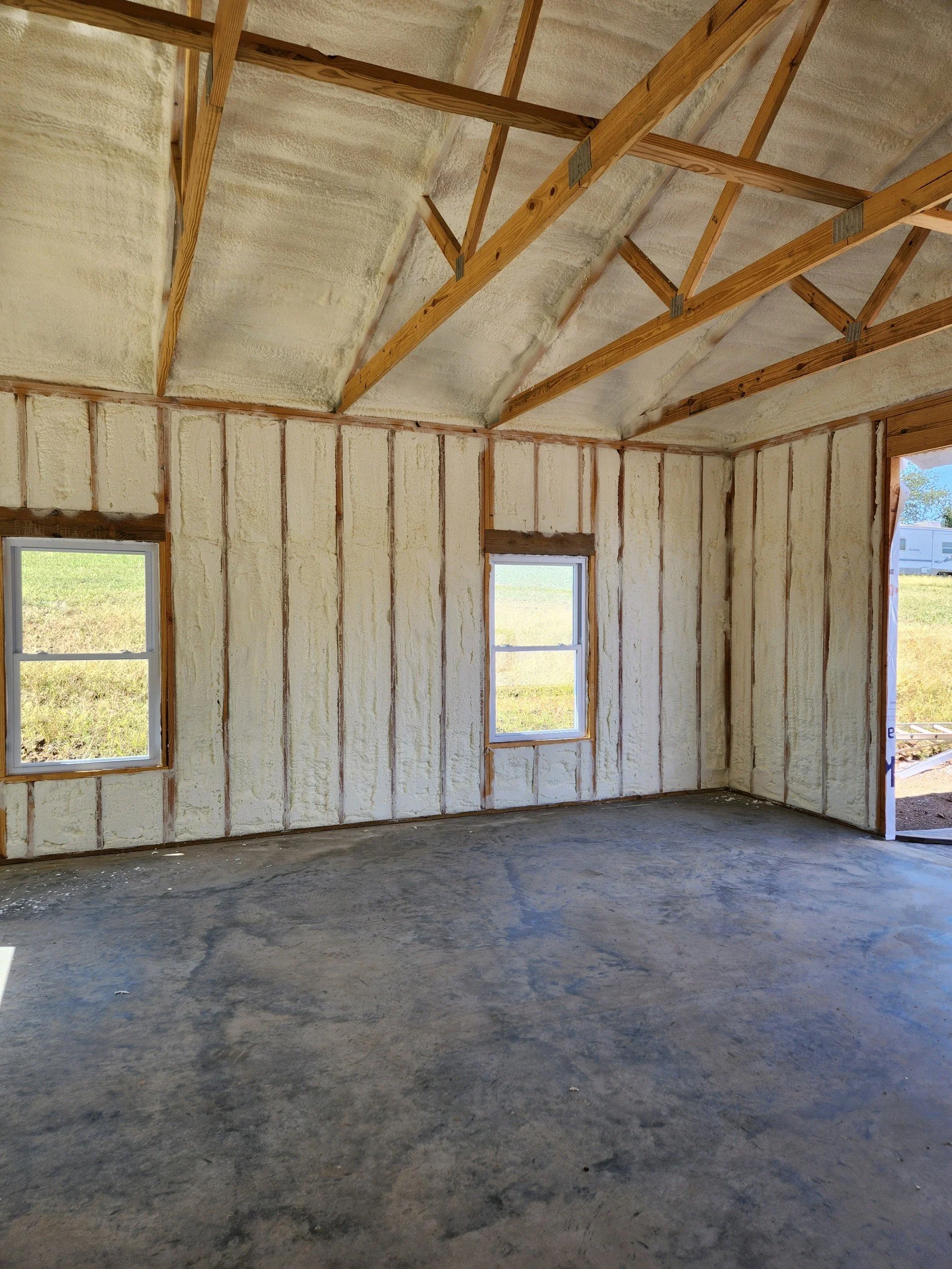
Closed Cell Foam
Where we go
EZ Seal Spray Foam LLC proudly serves the greater Kansas City metropolitan area and communities across eastern Kansas, providing professional open- and closed-cell spray foam insulation for homes, businesses, and agricultural buildings. Our team works hard to provide energy-efficient air sealing, moisture control, and superior R-value solutions tailored to local weather and building types. Whether updating older homes, insulating new construction, or improving comfort and efficiency in commercial and farm structures, we bring reliable scheduling, experienced installers, and industry-grade materials to every project across the Kansas City area and eastern Kansas.
Below is a practical list of counties and many of the cities/towns located on the general corridors between Fort Scott → Kansas City and Adrian, MO → Ottawa, KS. It’s not exhaustive of every small community, but covers primary counties and the most commonly served cities EZ Seal Spray Foam LLC would encounter along those routes and the surrounding service area.
Fort Scott → Kansas City corridor (southeast Kansas into the Kansas City metro)
Bourbon County, KS: Fort Scott, Bronson, Uniontown, Mapleton, Redfield
Crawford County, KS: Pittsburg, Frontenac, Arma, Cherokee, Mulberry
Labette County, KS: Parsons, Oswego, Cherryvale, Altamont
Neosho County, KS: Erie, Chanute, Galesburg, Stark
Allen County, KS: Iola, Moran, Humboldt, La Harpe
Anderson County, KS: Garnett, Colony, Kincaid
Franklin County, KS: Ottawa, Wellsville, Pomona, Princeton
Miami County, KS: Paola, Osawatomie, Louisburg, Spring Hill
Johnson County, KS: Olathe, Overland Park, Shawnee, Lenexa, Gardner
Wyandotte County, KS: Kansas City, KCK neighborhoods (Bonner Springs is in nearby Leavenworth County but serves KC metro)
Douglas County, KS (adjacent corridor areas accessible for some jobs): Lawrence
Adrian, MO → Ottawa, KS corridor (southwest Missouri into east-central Kansas)
Bates County, MO: Adrian, Butler, Rome, Foster
Cass County, MO: Harrisonville, Belton, Peculiar, Raymore
Johnson County, MO: Warrensburg, Kingsville, Knob Noster (note: some Johnson County, MO communities lie a bit off the direct route)
Platte County, MO (north part of route entering metro): Parkville, Platte City
Leavenworth County, KS: Leavenworth, Lansing, Linwood
Wyandotte County, KS: Kansas City (KCK)
Johnson County, KS: Edgerton, Gardner, Spring Hill (southern edge)
Franklin County, KS: Ottawa, Wellsville
Other nearby counties/cities frequently served within this broader region (useful for jobs slightly off the direct lines)
Leavenworth County, KS: Leavenworth, Lansing, Basehor
Jefferson County, MO: (if eastern KC metro east side jobs are requested) Festus, Arnold
Clay County, MO: Liberty, North Kansas City, Smithville
Platte County, MO: Parkville, Weston
Wyandotte & Johnson Counties (KS) and Jackson County, MO: core Kansas City metro including Kansas City, MO neighborhoods and suburbs
Morris County, KS and Lyon County, KS: Emporia and surrounding towns reachable for larger projects or commercial referrals
Greenwood, Elk, and Wilson Counties, KS: smaller rural towns between the southeast Kansas corridor and central Kansas service expansions
Notes for clients
If you have a specific address or town not listed, EZ Seal Spray Foam LLC will confirm whether it falls inside our service area and provide an onsite assessment.
We serve both residential and commercial properties across these counties, offering open-cell and closed-cell spray foam, and moisture-control solutions tailored to each climate zone and building code requirements.
Contact us
Interested in spray foam? Fill out some info and we will be in touch shortly. We can’t wait to hear from you!
